Author: Sunrise Barcelona

  • Six Ways Into a Barcelona Night Out (Three Of Them Free)

    There are six ways into a night out in Barcelona, and three of them cost nothing. Which one is right depends less on your budget than on one thing: whether you already have people to go out with.

    The short version

    You’ve already got people
    Free guest list
    Your group wants a table
    Free VIP list
    It’s eleven and you’ve decided
    A club ticket
    You got here on your own
    A hosted social pass
    Six of you, someone’s birthday
    A booked VIP table
    You’re here for a semester
    A student community

    How a Barcelona guest list actually works

    A guest list removes the cover charge and the main queue before a nightly cutoff. That is all it does.

    It does not guarantee entry. The door still decides, and what they decide on is almost always shoes. A list with the wrong footwear loses to no list with the right footwear.

    What is free is the access. You buy your own drinks inside, like everyone else.

    The cutoff is the expensive part

    Barcelona clubs price the night by the hour rather than charging a flat rate. Arrive with the instructions before the cutoff and you pay nothing. Arrive an hour later and you pay full price at the busiest moment of the night.

    Two people can pay completely different amounts to walk into the same room on the same night. The only difference is the hour.

    What a night out costs without a list

    Club entry at the doorUsually €15 to €20 with a drink, rising at the busiest hours
    Beer insideAround €7 to €8
    Spirit and mixerAround €10 to €12
    Cloakroom€2 to €4 per person

    Those are the going rates across the city. They move by night and by season.

    The six options, side by side

     Guest listVIP listTicketSocial passTableCommunity
    PriceFreeFreeFrom €12€17.91Groups of 6+Free
    What you getClub entryEntry, table, drinksClub entry3 events + clubTable, bottles, entryA group
    DeadlineBefore the cutoffBefore the cutoffNone22:30Booked aheadNone
    Host with youNoNoNoYes, all eveningNoAt events
    Good if you came aloneNoNoNoYesNoYes
    Best forYou just want inGroup wants a tableYou decided lateArriving aloneBig groupsA whole semester

    When free isn’t the right answer

    You decided late

    Nearly every list in this city shuts during the day. Fine if you knew at five that you were going out. Useless when the night turns into a night at half eleven, which is when most nights do. A ticket has no window and still beats the door price.

    You arrived on your own

    Free entry gets you through a door. It does not get you through the hours before it. The first bar fills at half ten and the club does not get going until one, and walking into a club at one where everyone came together from somewhere else is a specific kind of lonely.

    A hosted pass covers the evening instead of the door: a fixed start time, three social events with a host, and the whole group walking into the club together.

    You want the table guaranteed

    Table access on a free list is the venue’s call on the night. If you want it certain rather than likely, a booked table removes every unknown, and the minimum spend comes back to you as bottles rather than being charged as a fee.

    The one thing worth knowing

    Whatever you pick, arrive before the cutoff and wear clean shoes. Those two things decide more nights in Barcelona than any list does.

    Where to start

    If you’re unsure, start with something free. Three of the six cost nothing and none of them asks for a card.

    Free guest list Club tickets Social Access Pass VIP tables

  • What to Bring on a Night Out in Barcelona

    What to Bring on a Night Out in Barcelona

    Four things decide whether your night goes smoothly in Barcelona, and three of them fit in a pocket. The fourth is what you leave behind.

    This is not a packing list for a holiday. It is what to have on you between eleven at night and five in the morning in a city with a pickpocketing reputation and a metro that stops before the clubs do.

    The four things you actually need

    WhatWhy
    Physical photo IDEvery club is 18+ minimum and every door checks. A photo on your phone is not reliably accepted, and this is the number one reason people get turned away.
    One card and some cashMost places take card. Some bars have a minimum, some cloakrooms are cash only, and a taxi at five in the morning is easier with notes.
    Phone at 100%It is your map, your ride home, your group chat and your ID for the guest list. A dead phone at four in the morning is the actual worst case.
    A ride-hailing app, already set upUber, Cabify and FREE NOW all work in Barcelona. Install and register before you go out, not while standing on a pavement at four in the morning.

    The ID part, in detail

    Bring the physical document. Passport, national ID card or driving licence, whichever you have.

    Every venue in Barcelona is 18+ as a legal minimum, and some set their own limit higher, at 21 or 23. Those are house rules and they are enforced at the door regardless of how old the legal minimum is.

    Two practical points. Carrying a passport around a club all night is a risk in itself, so if you have a national ID card or a licence, use that instead. And if your passport is the only document you have, some people photograph it and leave the original in the safe. That works for some doors and not for others, so it is a gamble rather than a plan.

    What to leave in the room

    Barcelona is a safe city with a real pickpocketing problem, and the two facts coexist. The practical consequence is not fear, it is having less on you.

    • Your passport, if you have another accepted document.
    • All your cards. One is enough. Losing one card is annoying, losing four ruins a trip.
    • Anything you would be upset to lose. Jewellery, a second phone, headphones you like.
    • A bag you cannot see. A backpack on your back in a crowded room is open. A small bag worn across the front is not.

    More on that: is Barcelona safe at night.

    What to wear it in

    Front pockets, zipped if you have them. A small crossbody bag worn in front works and is normal here.

    What does not work: back pockets, an open tote, and a phone in your hand on a crowded street. The third one is how most phones go missing, and it happens on the walk between venues rather than inside them.

    On clothing itself, the door has opinions. Covered in the dress code guide, but the short version is that clean trainers and jeans get you into most places, and beachwear gets you into none.

    The things people wish they had

    Small, and each one has saved someone’s night.

    • A hair tie, if that applies to you. Clubs here get hot.
    • A screenshot of your accommodation address. Not a note in an app that needs signal. A screenshot, on your lock screen if you like. Taxi drivers do not always know a hostel by name.
    • The meeting point saved offline. Signal inside clubs is unreliable and basements have none.
    • A battery pack, if your phone is older than two years.
    • A jumper for the walk back, outside July and August. Barcelona nights in October are colder than the afternoon suggests.
    One habit is worth more than everything on this list: agree a meeting point with whoever you came with, before you go in. Not a plan to find each other, an actual place. Groups separate in every club, every night, and the ones who agreed a spot in advance do not spend an hour looking.

    What not to bother with

    • Printed tickets. Nobody asks. Your phone or your name on a list is enough.
    • Large amounts of cash. Card works nearly everywhere and cash is the one thing you cannot cancel.
    • A jacket you care about, if the venue has no cloakroom. It ends up on a chair.

    Or bring nothing and let us handle it

    Three hosted events across the evening, then the club with entry included and no queue. Meeting point sent in advance. Bring your ID and your phone.

    Get Tonight’s Pass

    Read next: how to get home once the metro stops and how club doors work here.

    Common questions

    Do I need my passport to get into a club in Barcelona?

    You need a physical photo ID. A national ID card or driving licence works and is safer to carry than a passport. A photo on your phone is not reliably accepted.

    Is a photo of my ID enough?

    No, not reliably. Some doors accept it and many do not, and it is the most common reason people are turned away. Bring the physical document.

    Do I need cash for a night out in Barcelona?

    Not much. Card works nearly everywhere. Some bars have a card minimum and some cloakrooms take cash only, so a small amount is useful. Large amounts are not.

    Which ride-hailing apps work in Barcelona?

    Uber, Cabify and FREE NOW all operate here. Install and register before you go out rather than on the street at four in the morning. Taxis can also be hailed on the street or booked by app.

    Are all clubs in Barcelona 18+?

    Eighteen is the legal minimum everywhere. Some venues set their own limit higher, at 21 or 23, and enforce it at the door as a house rule.

    Can I take a backpack into a club?

    Usually yes, but a backpack on your back in a crowded room is not something you can see. A small bag worn across the front is the better option and is normal here.

    Door policies and payment practices vary by venue. Information reflects general practice in Barcelona as of August 2026.

  • Three Nights in Barcelona: How to Plan Them

    Three Nights in Barcelona: How to Plan Them

    Three nights is the most common length of a Barcelona trip, and it is also the length people plan worst. Most itineraries fill the days and leave the nights to chance, which is how you end up doing the same thing three times.

    Here is a way to build three nights that are actually different from each other, without needing to know a single venue name in advance.

    The one rule that shapes everything

    Barcelona runs late, and not slightly. Dinner is at ten. Bars fill around half eleven. Clubs do not get busy until half one, and they close at five or six.

    That means an evening here has two halves, and the mistake is treating it as one. If you arrive at a club at eleven you will be alone in it. If you go to bed at midnight you missed the night entirely.

    The practical version: plan something for half nine to half twelve, and then decide whether the second half happens.

    Full timeline: what time Barcelona nightlife actually starts.

    Night one: stay central and low effort

    You have just arrived, you are probably tired, and you do not know the city yet. This is the wrong night to cross town.

    What works: dinner late in the Gothic Quarter or El Born, then bars in the same few streets. Both areas are dense enough that you can walk between five places in fifteen minutes, and everything is close to wherever you are staying if you are staying centrally.

    Whether it turns into a club night depends on how you feel at midnight. Leave that open rather than booking it.

    The thing worth doing on night one, whatever else you do: work out how you get home from the centre. The metro runs until 02:00 on Fridays and all night on Saturdays, but stops much earlier the rest of the week. Sorting that out once, sober, on night one, means never thinking about it again.

    Night two: the full night

    This is the night to commit. You know the city a bit, you have slept, and you have two more days.

    The structure that works: bars from half ten, and a club after one. Doing both in one night is what makes Barcelona feel like Barcelona, and doing it on night two means night three is not a write-off.

    Where depends on what you want, and the areas are genuinely different from each other rather than variations of the same thing.

    AreaWhat kind of night
    Port OlímpicBig beachfront clubs, commercial music, mostly visitors
    El BornBars and cocktails, no clubs, walkable, mixed crowd
    PoblenouLive music and smaller rooms, more local
    Poble SecTapas and bars, the most local of the central options
    Zona AltaDressed up, stricter doors, local crowd

    Comparison in detail: where to go out in Barcelona.

    Night three: do the opposite of night two

    If night two was a club night, night three should not be. Not because of energy, because of variety. Two identical big nights is one night twice.

    The alternatives that people underrate:

    • A rooftop before sunset, then a long dinner. Barcelona sunsets in summer land around half nine, which fits perfectly before a ten o’clock dinner.
    • Live music. Jazz and flamenco rooms run early, often finishing by midnight, so it is a full evening that does not cost you the next morning.
    • The beach at night. Free, and something you cannot do in Madrid.
    • A boat. Late afternoon rather than night, which leaves the evening open.

    If your three nights include a weekend

    The mix changes, and it is worth knowing which way.

    • Friday and Saturday are the busiest and the strictest at the door. Dress codes tighten and free entry usually becomes a discount.
    • Saturday is the night the metro runs through until morning, which makes it the easiest night to get home. Fridays it runs until 02:00.
    • Sunday is a real night here, unlike most of Europe. If your third night is a Sunday, it is not a lost night.
    • Midweek is cheaper, emptier and the doors are easier. If you have the choice, a Wednesday out beats a Saturday out on everything except atmosphere.

    The three mistakes on a three-night trip

    Going out on night one as hard as night two. You arrive tired, you burn the first night, and the good one becomes the recovery one.

    Booking all three nights in advance. You do not know how you will feel, and Barcelona is not a city where you need to book a bar. Book the thing you actually care about and leave the rest open.

    Not eating. Dinner at ten sounds late until you realise the alternative is drinking from nine on an empty stomach. Everyone here eats before going out, and that is why the night lasts until five.

    The simple version of night two

    Three hosted events across the evening, then the club with entry included and no queue. Turn up alone and leave with a group. Free cancellation up to 24 hours before.

    Get Tonight’s Pass

    Read next: what a night out costs and how to get home once the metro stops.

    Common questions

    Is three nights enough for Barcelona?

    For the nightlife, yes, comfortably. Three nights lets you do one central low-key night, one full night with bars and a club, and one that is something different. Doing the same big night three times is the actual risk.

    Which night should be the big one?

    The second. You have slept, you know the city a little, and you still have a night left afterwards. Night one you are tired and night three you want variety rather than a repeat.

    What time should I go out in Barcelona?

    Dinner around ten, bars from half eleven, clubs after one. Arriving at a club before midnight means arriving at an empty room.

    Is it worth going out on a Sunday in Barcelona?

    Yes. Barcelona has a real Sunday club scene, which most European cities do not. A third night falling on a Sunday is not a lost night.

    Should I book my nights in advance?

    Book the one thing you care about and leave the rest open. Bars here do not need booking, and you will not know how you feel until you are there.

    Is midweek better than the weekend?

    Cheaper, emptier and easier at the door, yes. Friday and Saturday are busier and stricter, and free entry often becomes a discount. Saturday is also the night the metro runs through until morning, with Fridays running until 02:00.

    Timings reflect general practice in Barcelona and vary by venue and season. Information current as of August 2026.

  • Erasmus in Barcelona: How Student Nightlife Actually Works

    Erasmus in Barcelona: How Student Nightlife Actually Works

    Barcelona has more than 200,000 students across nine universities, a large share of them international. So the good news is you are not the only one arriving without a group.

    The less obvious news is that student nightlife here runs on rules nobody tells you, and they are not the ones you are used to.

    Midweek is the student night, not the weekend

    This is the single biggest difference from most countries, and it catches almost everyone out.

    Wednesday and Thursday are when free entry and guest lists are easiest, when the crowd is the most international, and when doors are the least strict. Friday and Saturday are the opposite: dress codes tighten, queues get longer, and free entry usually becomes a discount at best.

    If your budget is tight, go out midweek and treat the weekend as the expensive option. Everyone here works out eventually. Working it out in week one saves you real money.

    The guest list has a cutoff, and the cutoff is the whole game

    Most venues that let you in free do it only before a certain hour. Miss it and you pay full price at the door for exactly the same night.

    The pattern to remember: free before a cutoff, discounted for a window after it, full price beyond that. The specific hours vary by venue and by night, and they change, which is why anyone giving you exact times in an article is guessing.

    What does not change: you have to sign up during the day. A guest list is not something you join at the door.

    Every venue in Barcelona is 18+ minimum, but not every venue is 18+. Some are 21+ and some are 23+. If you are eighteen or nineteen, check before you walk across the city.

    Get the cards in your first week

    Three cards cover almost everything a student gets discounted in Spain, and most people find out about them in month three.

    CardWhat it isWorth it for
    ESN cardThe official membership card of the Erasmus Student Network in SpainStudent events, trips and partner discounts
    Carnet JoveCatalonia’s youth cardTransport, culture, shops across the region
    ISICInternational Student Identity CardDiscounts outside Spain too, useful if you travel

    Your university ID alone already gets you into a lot of attractions at a reduced rate. Carry it.

    Transport, which is cheaper than you think

    A single journey is around 2.90 EUR, but nobody who lives here buys singles. The monthly travelcard for one zone is around 22.80 EUR for unlimited trips, which pays for itself in about eight journeys.

    The thing that matters for nights out: the metro does not run through the night most days. It runs until 02:00 on Fridays and the eve of public holidays, all night on Saturdays, and all night during Sant Joan and La Mercè. Every other night it stops well before clubs close, so the way home is a taxi, a ride-hailing app or a night bus. Sort out the app before you need it at four in the morning, not after.

    Full detail on that: getting home after a night out in Barcelona.

    Where students actually live

    Gràcia is the classic international student area, and it earns it. Village-like, full of small squares, and walkable at night. It is also not cheap.

    The nightlife implication: Gràcia is close to the Zona Alta clubs and a long way from the beachfront ones. If you end up living there, your default night looks different from someone living in El Raval.

    Comparison of the areas: where to go out in Barcelona.

    The mistakes that cost the most

    • Arriving after the cutoff. Same night, double the price. Nothing else on this list costs as much.
    • Not carrying physical ID. A photo on your phone is not reliably accepted anywhere. It is the most common reason people get turned away.
    • Going out Friday and Saturday only. The two most expensive and strictest nights of the week.
    • Buying single metro tickets. The monthly card pays for itself in about eight journeys.
    • Waiting for your course to make friends for you. Most people arrive alone. The ones who end up with a group are the ones who went to something in the first week.

    Why Barcelona over Madrid, honestly

    Madrid has more students than Barcelona and it is cheaper across the board.

    Barcelona is smaller, more expensive, and has a beach inside the city. It ranks among the top European cities in the QS Best Student Cities index, and the international student scene here is more concentrated, which makes it easier to find if you have just landed.

    If you are choosing on budget, Madrid wins. If you are choosing on lifestyle, this one does. Both are true.

    Your first week, sorted

    Three hosted events across the evening and club entry included, every night of the week. You turn up alone and leave with a group. Free cancellation up to 24 hours before.

    Get Tonight’s Pass

    Read next: how guest lists and door prices actually work and what a night out costs.

    Common questions

    Which nights are student nights in Barcelona?

    Wednesday and Thursday. Free entry and guest lists are easiest midweek, the crowd is the most international, and doors are the least strict. Friday and Saturday are the strictest and most expensive nights.

    Can I get into clubs in Barcelona at 18?

    Into many of them, yes. Eighteen is the legal minimum and a lot of venues work on that. But some set their own limit at 21 or 23, so check before you travel across the city.

    What is the ESN card?

    The official membership card of the Erasmus Student Network in Spain. It gets you into student events and gives partner discounts. Worth getting in your first week alongside the Carnet Jove and, if you plan to travel, an ISIC.

    How much is transport for a student in Barcelona?

    A single journey is around 2.90 EUR, and the monthly travelcard for one zone is around 22.80 EUR for unlimited trips. The monthly card pays for itself in about eight journeys.

    Where do Erasmus students live in Barcelona?

    Gràcia is the classic choice, with small squares, a village feel and a large international crowd. It is not the cheapest area, and it sits closer to the Zona Alta clubs than to the beachfront ones.

    Is Barcelona or Madrid better for Erasmus?

    Madrid is cheaper and has more students. Barcelona is more expensive but has a beach in the city and a more concentrated international scene, which is easier to break into when you first arrive.

    Student card schemes, transport fares and door policies reflect publicly available information as of August 2026 and are subject to change. Check current fares before you travel.
  • Barcelona vs Madrid vs Ibiza: Which One for a Night Out

    Barcelona vs Madrid vs Ibiza: Which One for a Night Out

    Three cities, three completely different nights, and a lot of guides that tell you all three are amazing. Here is the version with numbers in it.

    Worth saying upfront: we run nights in Barcelona, so we have an interest here. That is exactly why this article gives you the cases where Barcelona is the wrong answer.

    The short version

    BarcelonaMadridIbiza
    Club entry15 to 25 EUR10 to 20 EUR20 to 50 EUR standard, 55 to 120 for a big DJ
    A drink insideBeer 7 to 8 EUR, spirit and mixer 10 to 128 to 12 EUR12 to 20 EUR, cocktails over 20
    A realistic night50 to 80 EUR40 to 70 EUR100 to 200 EUR
    VIP table minimumfrom around 300 EURfrom around 300 EUR800 to 1,500 EUR
    SeasonAll yearAll yearSummer only, roughly May to early October
    BeachIn the cityNone, around 350 km awayEverywhere
    Clubs close5 to 6am6am6 to 8am
    Best forBeach and city in one tripBars, density, valueWorld-class DJs

    Ibiza: the most expensive night in Europe

    Ibiza is not a more expensive version of the other two. It is a different product with a different price ceiling.

    Standard entry at the big clubs runs 20 to 50 EUR, but a headline DJ night is 55 to 120, and opening or closing parties reach 150 and above. Drinks are 12 to 20, cocktails go past 20, and a bottle of water costs 5 to 7.

    A realistic budget for one superclub night is 100 to 200 EUR per person, and an opening or closing night pushes that to 300.

    The schedule is also later than anywhere else. Doors from 23:00, serious crowds around 01:00, headline sets at 03:00 or 04:00, closing between 06:00 and 08:00. And it is a summer product: the club season runs roughly from May to early October, with exact dates announced each year.

    Go to Ibiza if the DJ lineup is the reason for the trip and the budget is not the constraint. The superclub circuit there does not exist anywhere else in Spain.

    Do not go outside the summer season, because the big clubs shut and the island goes quiet. Opening and closing dates are announced each year, so check before booking.

    Madrid: the best value of the three

    Madrid is genuinely cheaper, and not by a rounding error. Entry at the top clubs is 10 to 20 EUR, drinks 8 to 12, and the guest list culture there means free or discounted entry at most venues if you sort it during the day.

    It also goes later than Barcelona. Madrid clubs peak between 03:00 and 06:00, and the bar scene treats a 4am close as normal rather than notable.

    The density is the real argument. Malasaña and Chueca put dozens of bars within a few streets, so a night out does not require planning or transport.

    Go to Madrid if you want the most nights out for the least money, and you care more about bars than about beach clubs.

    Do not go if you want to combine the night with sea and sand. Madrid is around 350 kilometres from the nearest coast, and that is the one thing it cannot offer.

    Barcelona: the only one that does all three

    Barcelona is more expensive than Madrid and much cheaper than Ibiza. Entry 15 to 25, a beer 7 to 8 and a spirit and mixer 10 to 12, a realistic night 50 to 80.

    That middle position is usually described as a compromise. It is not. It is the only one of the three where you can spend the afternoon on a beach inside the city, have dinner in a medieval quarter, and be in a club by one in the morning, in the same day, in any month of the year.

    Ibiza has the beach but no city and no winter. Madrid has the city but no beach. Barcelona has both, all year.

    Go to Barcelona if you want one trip that covers day and night, or if you are travelling outside the summer.

    Do not go if the specific DJ you want to see is playing in Ibiza. No amount of city beats a lineup.

    The comparison nobody makes: cost per night out

    Most comparisons quote a daily budget for the whole trip, which hides the thing that matters. Here it is per night, entry plus a few drinks plus getting home.

    • Madrid: 40 to 70 EUR. Cheapest, and the guest list can take the entry to zero.
    • Barcelona: 50 to 80 EUR. Middle, and the entry drops if you arrive before the price tier changes.
    • Ibiza: 100 to 200 EUR. Two to three times either of the others for the same number of hours.

    Put another way: three nights in Ibiza costs roughly what a week costs in Madrid.

    If you only have one weekend

    • First trip to Spain: Barcelona. Beach, city and night in one place, and easy to get around on foot.
    • Tight budget: Madrid. Cheaper at every line of the bill.
    • Music is the point: Ibiza, during the summer season only.
    • Travelling in winter: Barcelona or Madrid. Ibiza is closed.
    • Travelling alone: Barcelona or Madrid. Both have organised social nights, which Ibiza mostly does not because the clubs are the destination.

    If it’s Barcelona

    Three hosted events across the evening and club entry included, every night of the week. You turn up on your own and leave with a group.

    Get Tonight’s Pass

    Read next: what a night out in Barcelona actually costs and what time the night starts here.

    Common questions

    Which is cheapest for a night out?

    Madrid. Entry 10 to 20 EUR and drinks 8 to 12, with guest list culture that often removes the entry entirely. Barcelona sits about 10 to 15 percent higher across the board.

    How much more expensive is Ibiza?

    Two to three times either of the others per night. A standard club night in Ibiza is 100 to 200 EUR per person against 50 to 80 in Barcelona and 40 to 70 in Madrid.

    Can I go to Ibiza in winter?

    Not for clubbing. The club season is a summer one, running roughly from May to early October, with exact opening and closing dates announced each year. Outside that window the superclubs are shut.

    Which city goes latest?

    Ibiza, where clubs close between 06:00 and 08:00. Madrid closes around 06:00 and Barcelona between 05:00 and 06:00. All three are later than most of Europe.

    Which is best if I’m travelling alone?

    Barcelona or Madrid. Both have organised social nights where you turn up alone and join a group. Ibiza is built around the clubs themselves, so meeting people is more down to chance.

    Which has the best beaches near the clubs?

    Ibiza for the beaches themselves, Barcelona for having them inside the city. Madrid has none, being around 350 kilometres from the nearest coast.

    Prices reflect publicly available information as of August 2026 and vary by venue, night and season.

  • Barcelona Festivals Month by Month: Which Ones Change the Night

    Barcelona Festivals Month by Month: Which Ones Change the Night

    Barcelona has a festival almost every month, and plenty of guides will list all of them. Fewer will tell you which ones actually change what your night looks like.

    Some fill the streets until four in the morning. Some are a lovely afternoon and then everyone goes home. If you are choosing when to visit, that difference matters more than the lineup.

    The year at a glance

    MonthWhat’s onWhat it isChanges the night?
    FebruaryLlum BCNLight art installations across PoblenouEvening, not late
    FebruarySanta Eulàlia & CarnivalWinter festival with giants and human towers, plus carnival paradesSome late nights
    AprilSant JordiBooks and roses across the whole city, on the 23rdNo, it’s a daytime thing
    JunePrimavera SoundIndie, rock and electronic at Parc del FòrumYes, heavily
    JuneSónarElectronic music and digital arts, day and night programmesYes, heavily
    JuneSant JoanBonfires and fireworks on the beaches, night of the 23rdThe biggest night of the year
    June to AugustGrecCity summer festival of theatre, dance and musicEvening, not late
    AugustFesta Major de GràciaA week of decorated streets and street parties in GràciaYes, every night
    AugustFestes de SantsThe same idea in Sants, right after GràciaYes, quieter version
    SeptemberLa MercèThe city’s own festival. Hundreds of free events over five daysYes, and it’s free
    AutumnVoll-Damm Jazz FestivalJazz across venues, over several weeksDepends on the night
    Exact dates shift every year and are usually confirmed a few months ahead. The month and the pattern stay the same. Always check the official site before booking flights around one.

    The four that actually change the night

    Sant Joan, the night of 23 June

    If you only align your trip with one thing, make it this. Sant Joan is the shortest night of the year and Barcelona spends all of it outside. Bonfires on the beaches, fireworks going off from every direction, and the whole city on the sand until sunrise.

    It is not a ticketed event and there is no lineup. It is the city itself. Clubs run all night, the beaches are packed, and the metro runs through.

    What to know: it is loud, crowded and there are fireworks at ground level everywhere. Wear shoes you do not mind losing, keep your phone in a zipped pocket, and agree a meeting point with whoever you are with, because you will lose them.

    Festa Major de Gràcia, August

    For a week, the residents of Vila de Gràcia decorate their own streets by hand and compete for the best one. The results are genuinely astonishing, and each decorated street runs its own bar and its own music until late.

    It is free, it is outdoors, and it is the most local thing on this list. The crowd is Barcelona, not visitors. Festes de Sants follows immediately after in the neighbouring district, with the same format and fewer people.

    Primavera Sound and Sónar, June

    These two fill the city with a festival crowd for a week each, and that changes the clubs whether or not you have a ticket.

    Primavera runs at Parc del Fòrum with a capacity around 75,000. Sónar splits into a daytime programme and a night one at a different venue. Both spawn official and unofficial afterparties across the city, which is where a lot of the good nights actually happen.

    If you are here during either and did not buy a ticket, you will still have a better week than usual.

    La Mercè, September

    The city’s own festival, around 24 September, which is a local public holiday. Roughly five days and hundreds of free activities: human towers in Plaça de Sant Jaume, the correfoc fire run through the old town, free concerts across several stages, and a fireworks and music show on Montjuïc to close it.

    Almost all of it costs nothing, which makes it the best value week of the entire year to be here.

    Which month to pick

    • You want the single best night: late June, for Sant Joan.
    • You want music festivals: June, for Primavera and Sónar.
    • You want it free and local: August for Gràcia, or September for La Mercè.
    • You want fewer crowds: February. Llum BCN and Carnival, and the city to yourself.
    • You want warm and quiet: late May or early October. No festival, good weather, everything open.
    Book accommodation early for June and September. Primavera, Sónar and La Mercè each fill the city, and prices move accordingly.

    What does not change

    Whatever month you land in, the clubs run every night of the week and the rhythm of an evening is the same: dinner late, bars from around half ten, clubs filling around one thirty. Festivals add to that, they do not replace it.

    Whatever week you’re here

    Three hosted events across the evening and club entry included, seven nights a week. At least 40 travellers on the night, or your money back.

    Get Tonight’s Pass

    Read next: what time the night actually starts here and what a night out costs.

    Common questions

    What is the biggest party night in Barcelona?

    Sant Joan, the night of 23 June. Bonfires and fireworks on the beaches, and the whole city outside until sunrise. It is not ticketed and it is not organised by anyone. It just happens.

    When is La Mercè and is it free?

    Late September, around the 24th, which is a local public holiday. Hundreds of activities across roughly five days, and almost all of them are free.

    What is the Festa Major de Gràcia?

    A week in August when residents of the Gràcia district decorate their own streets by hand and compete for the best one. Each street runs its own bar and music. Free and outdoors.

    Is it worth visiting during Primavera Sound if I don’t have a ticket?

    Yes. The festival fills the city with a music crowd and generates official and unofficial afterparties across Barcelona for the week.

    Which month is quietest for visiting Barcelona?

    February. Llum BCN and Carnival are on, the weather is mild, and the city is emptier than at any other point in the year.

    When should I book accommodation?

    Early for June and September. Primavera, Sónar and La Mercè each fill the city and prices rise well in advance.

    Festival months and formats reflect the recurring annual pattern. Exact dates change each year and are confirmed by organisers a few months ahead. Information current as of August 2026.

  • Which Barcelona Club Is Open Each Night of the Week

    Which Barcelona Club Is Open Each Night of the Week

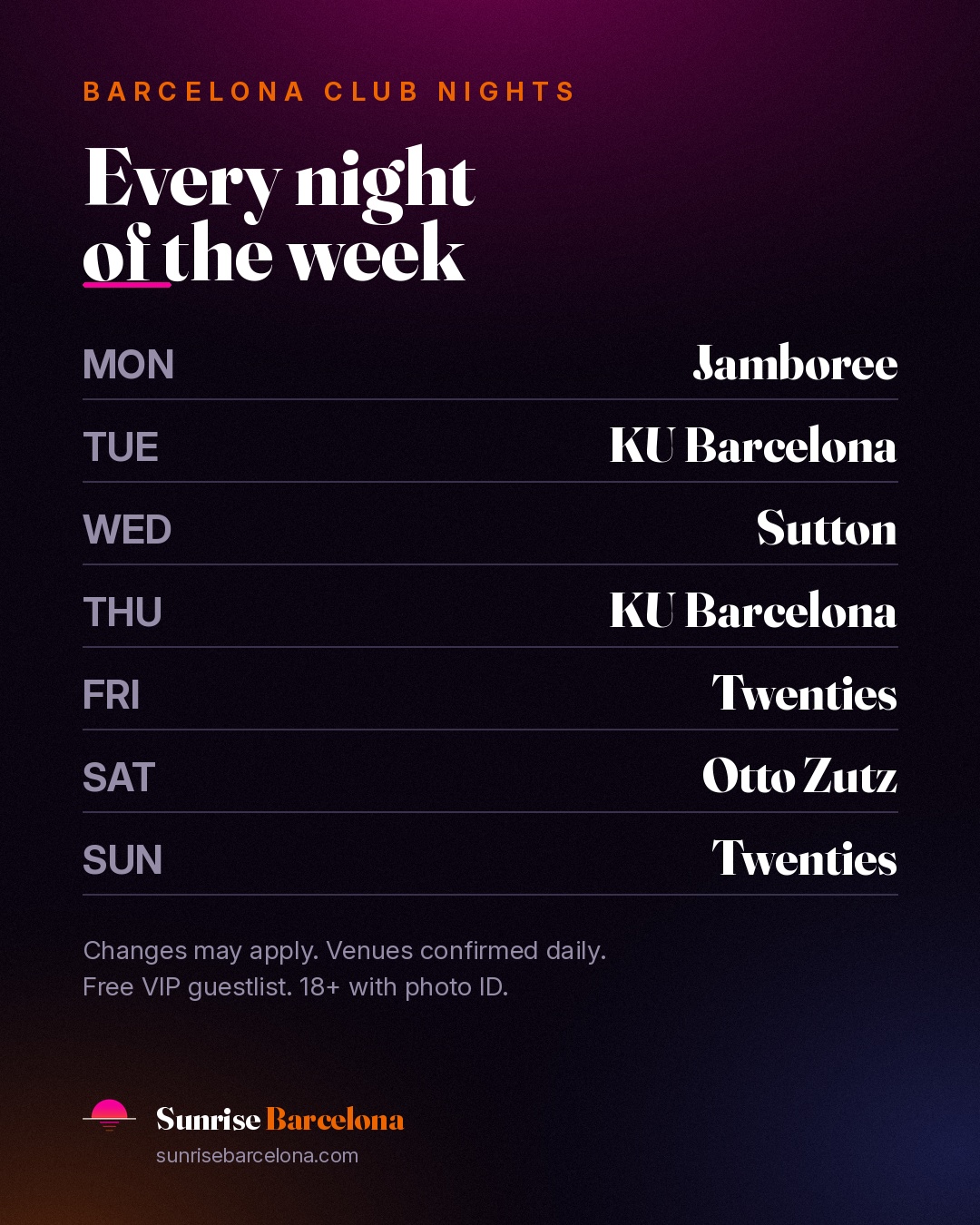
    Barcelona has a club open every night of the week, which is not true of most European cities. What changes is which one, and almost nobody publishes that.

    Here is the rota as it usually runs, what each venue is actually like, and how strict the door is. Clubs and nights do change, so treat this as the pattern rather than a timetable.

    The week at a glance

    NightClubAreaMusicDoor
    MondayJamboreePlaça Reial, Gothic QuarterHip hop, R&B, funk, plus an 80s and 90s roomRelaxed
    TuesdayKU BarcelonaPort OlímpicHouse, commercial, reggaetonSmart casual
    WednesdaySuttonZona AltaCommercial and houseThe strictest in the city
    ThursdayKU BarcelonaPort OlímpicHouse, commercial, reggaetonSmart casual
    FridayTwentiesEixampleCommercial and LatinSmart casual
    SaturdayOtto ZutzSant GervasiHip hop, R&B, reggaeton, commercialCasual
    SundayTwentiesEixampleCommercial and LatinSmart casual
    Changes may apply. Clubs swap nights, close for private events and add one-off parties, so the venue for any given night is confirmed daily rather than fixed in advance.

    Monday: Jamboree

    A club open on a Monday is unusual anywhere. Jamboree does it because it opens every day of the year.

    It sits directly on Plaça Reial in the Gothic Quarter, which makes it the easiest venue on this list to reach on foot from anywhere central. Two rooms: the main one plays hip hop, R&B and funk, and the Tarantos room plays eighties and nineties.

    Door entry runs around 15 EUR with a drink included. The door is relaxed compared with the beachfront clubs, and the room is smaller, which on a Monday is the point.

    Tuesday and Thursday: KU Barcelona

    KU is the venue that operated as Pacha Barcelona for over a decade, until that franchise agreement ended in late 2025. Same building on Port Olímpic, same terrace, different name.

    Entry is priced by arrival time. Around 10 EUR shortly after midnight, closer to 15 an hour later, and around 20 by one in the morning, with the same drink included either way. Arriving early is the cheapest thing you can do on a KU night.

    Smart casual minimum. Clean trainers pass, sportswear and beachwear do not.

    Wednesday: Sutton

    Sutton has the most selective door in Barcelona, and that is the single most useful thing to know about Wednesdays.

    It is up in Zona Alta rather than by the beach, and the crowd skews local rather than visiting. Proper shoes, a smart top, no streetwear. If you turn up in what got you into Otto Zutz on Saturday, you may not get in.

    Entry generally runs 20 to 30 EUR at the door.

    Friday and Sunday: Twenties

    Twenties sits in Eixample, away from both the beach and Zona Alta, which makes it the most central of the weekend options. Commercial and Latin music, and a crowd that is a mix of visitors and locals.

    A Sunday club night is another thing Barcelona does that most cities do not. If you are here for a short trip and Sunday is one of your nights, it does not have to be a write off.

    Saturday: Otto Zutz

    Otto Zutz has been on Carrer de Lincoln in Sant Gervasi since 1985, in a converted textile factory. Three floors with different music on each: hip hop and R&B, reggaeton and Latin, and commercial hits.

    It has the most relaxed door of any big club in this list. Clean casual is fine for everyone, and you do not need the Sutton treatment. Beachwear is still out. Doors open around midnight and it runs until six.

    Cocktails land around 10 to 15 EUR. Table minimums start around 300. Nearest metro is Fontana on the green line, about five minutes on foot.

    How to pick your night

    • You want the easiest door: Saturday at Otto Zutz, or Monday at Jamboree.
    • You want to dress up: Wednesday at Sutton.
    • You want the beachfront: Tuesday or Thursday at KU.
    • You want central and simple: Friday or Sunday at Twenties.
    • You want the cheapest way in: any night, before the price tier changes. Arriving before one in the morning saves more than any code.
    Every club on this list is 18+ and every door checks physical photo ID. A photo of your passport on your phone is not reliably accepted, and this is the most common reason people get turned away.

    Tonight’s club, confirmed daily

    The venue, the time and the meeting point are posted every day before the night starts. Club entry is included with the Social Access Pass, with skip the line access.

    Get Tonight’s Pass

    Read next: what each door expects you to wear and how the areas of Barcelona compare.

    Common questions

    Is there a club open in Barcelona on a Monday?

    Yes. Jamboree on Plaça Reial opens every day of the year, with hip hop and R&B in the main room and an eighties and nineties room alongside it.

    What is open on a Sunday night?

    Twenties in Eixample usually runs on Sundays. Barcelona has a real Sunday club scene, unlike most European cities.

    Which club has the strictest door?

    Sutton, in Zona Alta. Proper shoes and a smart top rather than streetwear, and a crowd that skews local.

    Which club has the most relaxed door?

    Otto Zutz in Sant Gervasi. Clean casual is fine, three floors with different music, and it runs until six in the morning.

    Is Pacha Barcelona still open?

    The venue is open but not under that name. It became KU Barcelona in late 2025 when the franchise agreement ended. Same location on Port Olímpic.

    Does the club rota ever change?

    Yes, regularly. Clubs swap nights, close for private events and add one-off parties. The venue for any given night is confirmed on the day rather than fixed weeks in advance.

    Venues, prices and door policies reflect publicly available information as of August 2026 and vary by night, season and event.

  • Is Barcelona Safe at Night? A Practical Answer

    Is Barcelona Safe at Night? A Practical Answer

    Barcelona is a safe city to go out in, and it has a pickpocketing problem. Both of those are true at once, and confusing them is why people arrive either unprepared or unnecessarily nervous.

    Spain ranks 23rd of 163 countries in the Global Peace Index, and Barcelona is one of the cities travellers name most often for a solo trip. What visitors actually experience here is opportunistic theft in crowds, not confrontation.

    The real risk, and how it works

    Pickpocketing in Barcelona is skilled, quiet and non-violent. It happens where crowds are dense and attention is elsewhere: La Rambla, the metro, busy bars, the moment a group takes a photograph.

    Nobody grabs anything. That is the point. You find out later.

    The countermeasures are dull and they work:

    • Bag closed and in front of you in any crowd or on the metro
    • Phone in a zipped or front pocket, never a back pocket
    • Nothing valuable on the table in a bar, including a phone
    • Card and a small amount of cash, not everything you own
    • Passport left where you are staying unless a club specifically requires it
    Clubs require photo ID for entry. If your accommodation has a safe, a national ID card is easier to carry than a passport. If a passport is your only document, keep it in an inside pocket rather than a bag.

    Areas, honestly

    Port Olímpic and the beachfront are busy, well lit and heavily policed at night. The main issue is the volume of people, which is the environment pickpockets prefer.

    El Born and the Gothic Quarter hold most of the city’s pickpocketing. The streets are narrow and crowded and it is easy to be distracted. It is not a dangerous area, it is a busy one.

    Poblenou and Poble Sec are quieter, more residential, with fewer crowds and correspondingly less of the problem.

    The beach itself after dark is the one place worth avoiding on your own. It is unlit, empty in stretches, and there is no reason to be there at four in the morning.

    The part that actually keeps people safe

    Not walking home alone across the city at five in the morning is worth more than every other tip combined. The metro does not run through the night except on Saturdays, so the plan has to be a taxi, Cabify or a night bus, decided before you go out rather than at closing time.

    Uber does not operate legally in Barcelona. Cabify is the local equivalent and shows the driver, the route and the fare before you get in. Install it before your trip.

    Drinks

    Standard practice applies and it is not paranoia: keep your drink with you, do not accept one from a stranger you have not watched it poured for, and if a drink tastes wrong, leave it. Any venue will get you a member of staff if you ask.

    Going out alone

    Arriving somewhere alone at two in the morning is the situation worth avoiding, less for safety than because it is a poor way to spend an evening. Meeting people earlier changes both.

    The practical version: be somewhere with people by eleven, and reach the club as part of a group rather than by yourself. That is a scheduling decision, and it is the one that makes the rest of the night straightforward.

    Arrive with people, leave with people

    Hosted events run through the evening with a host present at each one, so you are not walking into a room of strangers at two in the morning on your own.

    Get Tonight’s Pass

    Read next: getting home once the metro has stopped and going out alone as a woman in Barcelona.

    Common questions

    Is Barcelona safe at night?

    Yes, broadly. Spain ranks 23rd of 163 countries in the Global Peace Index. The issue visitors actually encounter is pickpocketing rather than violent crime.

    Where does pickpocketing happen most?

    La Rambla, the metro, and the crowded streets of the Gothic Quarter and El Born. Dense crowds and distracted attention are the pattern.

    Should I carry my passport?

    Clubs require photo ID. A national ID card is easier to carry than a passport. If a passport is your only document, keep it in an inside pocket rather than a bag.

    Is it safe to walk home at night?

    Short distances on lit, busy streets are generally fine. Crossing the city alone at five in the morning is worth a taxi.

    Is the beach safe at night?

    The beach after dark is the one area worth avoiding on your own. It is unlit and empty in stretches.

    What do I do if something is stolen?

    Report it to the Mossos d’Esquadra, in person or online, and cancel your cards immediately. Insurers generally require a police report.

    Safety information reflects publicly available sources as of August 2026 and is general guidance rather than advice for any specific situation.

  • Where to Go Out in Barcelona: The Areas Compared

    Where to Go Out in Barcelona: The Areas Compared

    Barcelona does not have a nightlife district. It has four or five, they are nothing like each other, and picking the wrong one for the night you want is the difference between a great evening and standing somewhere expensive wondering why everyone looks different from you.

    The choice is less about which is best and more about what kind of night you are after: a big room by the sea, a small room with better music, or a street full of bars.

    The areas at a glance

    AreaBest forMusicPrice levelGetting home
    Port Olímpic Big clubs, first time in the city House, commercial, reggaeton Highest Easiest. Taxi ranks form outside
    Poblenou Music first, live gigs Indie, techno, electronic Mid Straightforward, taxis available
    El Born and Gòtic Bars, walking between places Mixed, bar music Mid Central, walkable, narrow streets
    Poble Sec Smaller venues, locals Electronic, alternative Lower Fine, slightly further out
    Eixample and Zona Alta Dressed up nights Commercial, house High Residential, quieter streets

    Port Olímpic and the beachfront

    This is the Barcelona most visitors picture: large rooms on the marina, terraces facing the sea, and the biggest names in the city within a couple of minutes’ walk of one another. Opium, KU and Shôko all sit here.

    It is the busiest area, the most expensive, and the one with the strictest doors. It is also the easiest to leave, because taxis queue outside as clubs empty, which matters more at five in the morning than it sounds now.

    If it is your first night in Barcelona and you want the version of the city you have seen in photographs, start here.

    Poblenou

    Razzmatazz sits in Poblenou, and it shapes the character of the whole area: several rooms under one roof, each playing something different, with a crowd that came for the music rather than the setting.

    Doors here barely have a policy. Nobody is inspecting your shoes. Prices sit below the beachfront across entry and drinks.

    El Born and the Gothic Quarter

    Bars rather than clubs, and the pleasure is walking between them. Narrow streets, small rooms, everything within a few minutes on foot. This is where an evening is built rather than where it ends.

    It is also the area where pickpocketing is most common in the city, which is a property issue rather than a personal safety one. Bag closed and in front of you, phone in a zipped pocket, and it stops being a consideration.

    Poble Sec

    Smaller venues, a higher proportion of locals, and prices that go further. Sala Apolo and the surrounding rooms sit around here. Less of a strip and more a set of specific places you go to on purpose.

    Eixample and Zona Alta

    Further up from the centre, more residential, and where Sutton sits with the most selective door in the city. The crowd skews local rather than visiting. If you want a night where people dressed for it, this is the area.

    How to choose in one line

    • First time in Barcelona: Port Olímpic
    • The music matters most: Poblenou or Poble Sec
    • You want to talk to people: El Born, then move on
    • You want to dress up: Zona Alta
    Most good nights in Barcelona use two areas rather than one. Bars in El Born or Poble Sec early, then a club on the beachfront later. The city is small enough that moving between them costs ten minutes in a taxi.

    Let someone else pick the route

    Hosted events run in the bars early and finish at a club later, so the areas are already chosen and you only have to turn up.

    Get Tonight’s Pass

    Read next: what each door expects you to wear and what time to actually turn up.

    Common questions

    Where is the main nightlife area in Barcelona?

    Port Olímpic on the beachfront holds the largest clubs and is where most visitors go, though the city has four or five distinct nightlife areas.

    Which area is cheapest for going out?

    Poble Sec and Poblenou sit below the beachfront on both entry and drinks.

    Where should I go on my first night?

    Port Olímpic, if you want the version of Barcelona nightlife you have seen in photographs and the easiest journey home.

    Where do locals go out?

    Poble Sec, parts of Poblenou, and Zona Alta hold a higher proportion of locals than the beachfront clubs.

    Can I walk between areas?

    Within El Born and the Gothic Quarter, easily. Between areas, a taxi takes around ten minutes and costs very little split between a few people.

    Which area is best for live music?

    Poblenou, where Razzmatazz runs several rooms and regular live gigs.

    Area and venue information reflects publicly available information as of August 2026 and varies by night and season.

  • Getting Home After a Night Out in Barcelona

    Getting Home After a Night Out in Barcelona

    The part of a Barcelona night out that goes wrong most often is the end of it. Clubs close around five or six in the morning, the metro stopped hours earlier, and a few hundred people walk out at once looking for the same thing you are.

    It is entirely manageable, but only if you sorted it before you went out rather than at five in the morning on a phone at four per cent battery.

    Your options at five in the morning

    OptionCostHow it works
    Street taxi Roughly 10 to 20 EUR across the city Metered, plentiful, and ranks form outside the big clubs as they empty
    Cabify, Uber and FREE NOW Similar, fare shown in advance App based, named driver, tracked route. All three operate in Barcelona
    Nitbus night bus Standard fare Runs through the night on set routes. Slow but reliable and very cheap
    Metro Standard fare Runs until 02:00 on Fridays, all night on Saturdays, and all night during Sant Joan and La Mercè. Stops earlier the rest of the week
    Walking Free Fine for short distances in lit, busy streets. Less so across the city alone

    The thing everyone gets wrong first

    The apps that work here are Cabify, Uber and FREE NOW, alongside street taxis. Install whichever you prefer and set up payment before your trip, not on the night. They behave the same way: you see the driver, the route and the fare before you get in.

    The single best habit: know the name of the metro stop nearest your accommodation, not just the street. Drivers know stops. Streets in the Gothic Quarter, less reliably.

    The metro, and the one night it helps

    Barcelona’s metro does not run through the night most days. Last trains leave well before clubs close, which catches out anyone assuming a European capital runs a night service.

    The exceptions are worth knowing. It runs until 02:00 on Fridays and the eve of public holidays, all night on Saturdays, and all night during Sant Joan in June and La Mercè in September. If your trip has flexibility, Saturday alone makes it the simplest night to go out.

    Night buses

    The Nitbus network covers the city through the night on fixed routes, most of them passing through Plaça de Catalunya. It is slower than a taxi and considerably cheaper, and it is a genuine option if you are not in a hurry and you are not alone.

    A short checklist before you leave

    • A ride-hailing app installed, account set up, payment method added
    • Your accommodation saved in the app, and the nearest metro stop written down
    • Phone charged, or a small power bank in a pocket
    • Enough cash for a taxi if the card fails
    • If you are with people, agree how everyone is getting back before the night starts

    That last one matters more than any of the others. Groups split at four in the morning without meaning to, and the person left working out the journey alone is the one having the worst night.

    Leave with people, not on your own

    An evening of hosted events means you reach the end of the night with a group rather than alone, which makes the journey home a shared problem instead of a solitary one.

    Get Tonight’s Pass

    Read next: how safe the city is at night and which area is easiest to leave.

    Common questions

    Which ride-hailing apps work in Barcelona?

    Cabify, Uber and FREE NOW all operate here, alongside street taxis, which are metered and widely available.

    Does the metro run all night in Barcelona?

    Not most nights. It runs until 02:00 on Fridays and the eve of public holidays, all night on Saturdays, and all night during Sant Joan and La Mercè. Every other night the last trains leave before clubs close.

    How much is a taxi across Barcelona at night?

    Roughly 10 to 20 euros for most journeys within the city, on the meter.

    Are there night buses?

    Yes. The Nitbus network runs through the night on fixed routes, most passing through Plaça de Catalunya. Slow but cheap and reliable.

    How long does it take to get across the city?

    Rarely more than fifteen or twenty minutes by taxi at night, since the traffic that clogs Barcelona by day has gone.

    Can I pay a taxi by card?

    Usually yes, but carrying some cash avoids the one time the terminal does not work.

    Transport information reflects publicly available information as of August 2026 and may change by season and service.